Recent scientific work translated into context, next steps, and reproducible artifacts.
This feed prescribes climate democracy by decentralizing sustainable (SDG5, scientific) intent.
This report examines a formal economic model suggesting that competition
can sustain over-automation even when firms recognize the resulting harm
to consumer demand. The key contrast is not technology versus humanity,
but individual incentives versus collective outcomes.
El Niño is not a deterministic forecast for every country or region.
It changes probabilities. This report examines how warming in the
tropical Pacific alters rainfall patterns, drought risk, storm tracks,
and preparedness planning in a world that is already unusually warm.
A developing AI-governance event around Anthropic model access shows why
Engineering Statements matter: preserve sources, constraints, evidence,
open questions, and next steps instead of amplifying isolated claims.
AGAPI provides open infrastructure for agentic science. Engineering Statements propose a
portable specification layer for claims, constraints, tools, evidence, workflows, and outputs.
As sustainability reporting shifts from voluntary pledges to mandatory
product-level evidence, this report examines Digital Product Passports,
sovereign data spaces, Agentic AI, and RegTech workflows for semiconductor
and petrochemical value chains.
A new framework for personalized physiological interpretation asks a
different question: not simply whether a measurement is normal, but what
it means relative to the individual person. Genetics-informed baselines
help distinguish stable predispositions from meaningful deviations,
transforming raw numbers into more interpretable signals. The same
observed value may carry different implications for different people. :contentReference[oaicite:0]{index=0}
Six new families of modular Nahm sums extend the known landscape of Nahm's problem.
The report highlights Rogers–Ramanujan identities, lift-dual constructions, and the
role of modular examples in higher-rank settings.
Prompted deception and trained deception are not the same problem.
This report explores belief-verified model organisms, detector transfer failures,
and what current lie-detection methods can—and cannot—support in AI auditing.
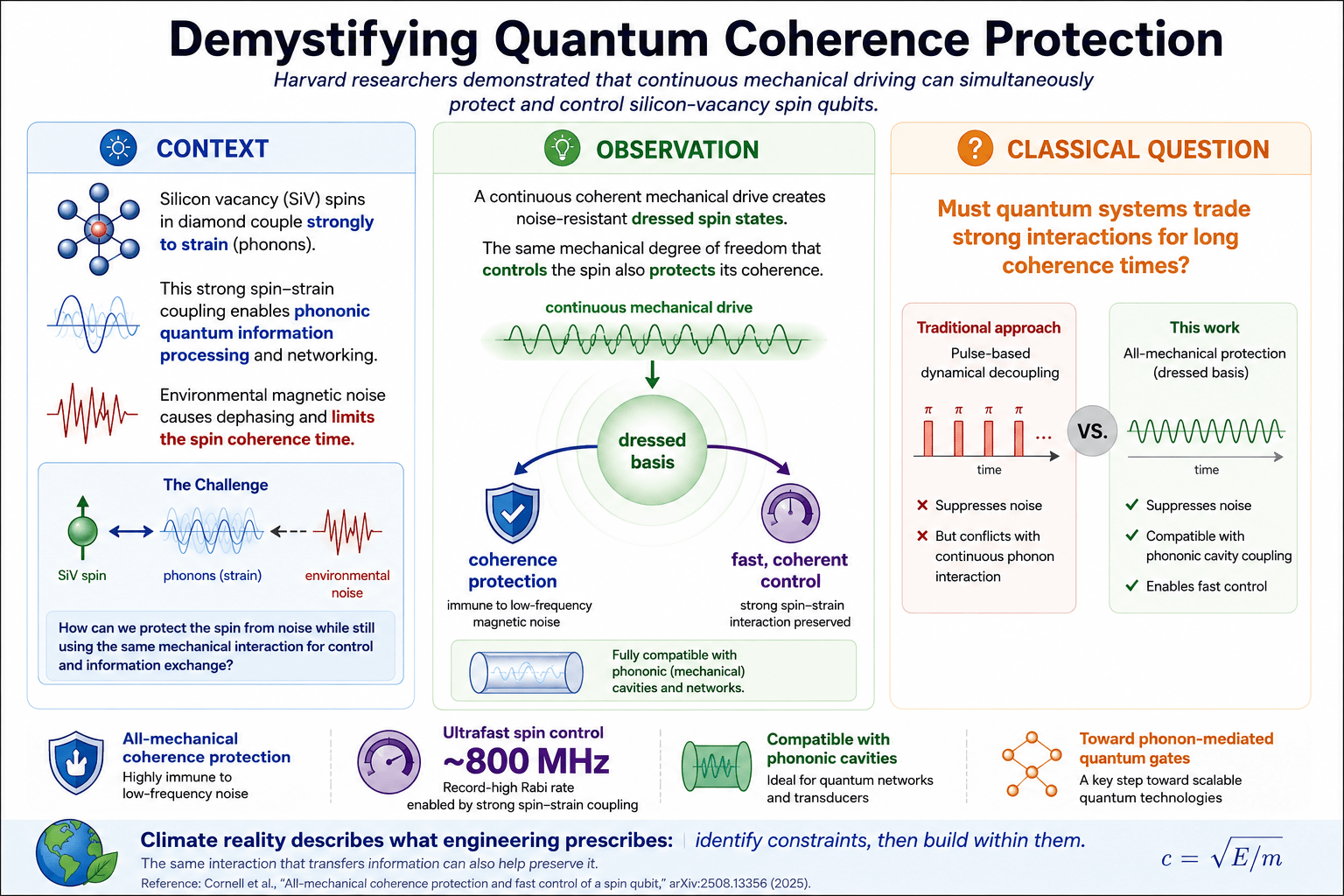
Harvard researchers demonstrated that continuous mechanical driving can
simultaneously protect and control silicon-vacancy spin qubits.
Mechanical driving creates dressed spin states that preserve coherence
while remaining compatible with phononic quantum devices.
Silicon-vacancy centers in diamond are promising quantum systems because
their electron spins couple strongly to strain. That strong spin-strain
interaction enables phonon-mediated quantum information transfer, but
environmental noise limits the spin coherence time.
The paper
All-mechanical coherence protection and fast control of a spin qubit
demonstrates a continuous coherent mechanical drive that creates
noise-resistant dressed spin states. The same mechanical interaction that
supports quantum control also helps protect the qubit from low-frequency
magnetic noise.
This matters because standard pulse-based dynamical decoupling can conflict
with controllable spin-cavity interactions. The mechanical approach keeps
coherence protection compatible with phononic cavities and networks.
The result includes ultrafast mechanically driven spin control, with Rabi
frequencies approaching 800 MHz. That benchmark shows how
strongly the silicon-vacancy spin responds to strain.
Climate reality describes what engineering prescribes:
identify constraints, then build within them.
Papers, tools, people, institutions, computation, energy, language, and attention exist in context.
Engineering Statements specify.
Scientific intent becomes next steps: claims, constraints, tools, evidence, workflows, and outputs.
Climate Democracy prescribes.
Shared artifacts support collaborative action instead of isolated certainty or private kingdoms.
arXiv Categories
Climate Reality can start with Number Theory and then focus-shift across other categories.
Each category is a place where scientific intent already exists.